
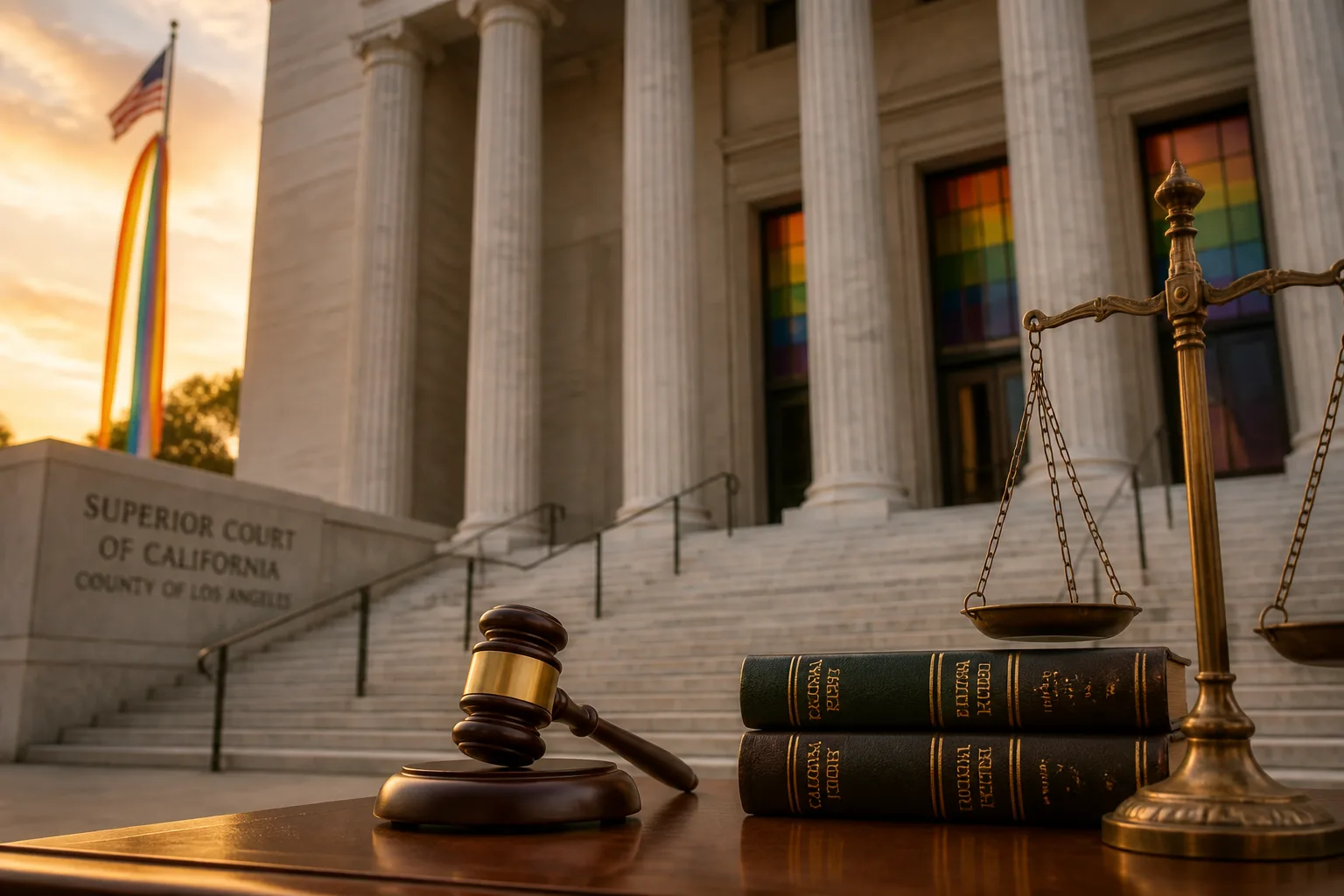
California Justice Marsha Slough, First Openly Gay Appeal Judge, Dies at 68
California Justice Marsha G. Slough, the first openly gay judge on the state’s Fourth District Court of Appeal, died Saturday after a brief illness. She was 68. Slough had served the California judiciary for more than twenty years, including a decade on the Judicial Council and nearly a decade on the appellate bench.
Slough was appointed to the Fourth District Court of Appeal, Division Two in Riverside, by Governor Jerry Brown in 2015. She had previously been named to the San Bernardino Superior Court by Governor Gray Davis in 2003. While in San Bernardino, she served as presiding judge of the county’s juvenile court from 2007 to 2010 and as presiding judge of the entire court from 2012 to 2015. Her appellate tenure was marked by the authorship of 454 opinions, of which 55 were published.
During her time on the Judicial Council, Slough chaired the Executive and Planning Committee and helped draft emergency rules that guided California courts through the COVID‑19 pandemic. Those rules were designed to reduce virus transmission in jails, limit evictions and foreclosures, and expand remote technology for court proceedings. She also led a statewide Workgroup on Post‑Pandemic Initiatives that reviewed practices adopted during the pandemic and promoted their continued use. In addition, she chaired the Pretrial Reform and Operations Workgroup, which launched pilot programs that are now active in all 58 counties.
Chief Justice Patricia Guerrero said Slough “leaves behind a legacy defined by integrity, intellect, and an unwavering devotion to the fair administration of justice.” The Judicial Council’s Administrative Director, Shelley Curran, noted that Slough’s “empathy, intellect, decisiveness, and kindness were apparent to everyone who had the privilege to know and work with her.” Former Chief Justice Tani G. Cantil‑Sakauye added that Slough “combined astute policies with compassionate leadership” and that she “worked tirelessly to improve justice in California.”
Slough retired from the Fourth District Court of Appeal in 2023. In a statement released at the time, she reflected on the past twenty years as a period that “afforded me the unique privilege of observing firsthand the importance of the rule of law and the true value in a commitment to justice for all.” She was survived by her spouse, Jill Sibler.
The California judiciary has lost a judge who was not only a pioneer for LGBTQ representation but also a leading voice on technology, pretrial reform, and pandemic response. Her work on the Judicial Council and the appellate bench has shaped policies that continue to influence courts across the state.
Slough’s career began with her appointment to the San Bernardino Superior Court in 2003, a position that placed her at the center of a county with a diverse population and a high caseload. Her leadership as presiding judge of the juvenile court and later of the entire court demonstrated her commitment to fair and efficient adjudication.
On the appellate level, Slough’s 454 opinions reflected a broad range of legal issues, from criminal law to civil rights. The 55 published opinions, which are cited by other courts, show the influence of her reasoning on California jurisprudence.
Her tenure on the Judicial Council coincided with the COVID‑19 pandemic, a period that required rapid adaptation. The emergency rules she helped craft allowed courts to conduct hearings remotely, reducing the risk of virus spread in jails and limiting the number of evictions and foreclosures during a period of economic hardship.
The pretrial reform pilots she helped launch have been credited with releasing more defendants pretrial and reducing rearrest rates, according to a 2023 report. The programs now operate in every county, illustrating the lasting impact of her work.
Slough’s legacy also includes her advocacy for court technology. She championed the adoption of electronic filing systems and remote hearing technology, improving court efficiency and access to justice.
Her death marks the end of a distinguished career that spanned two decades of public service. The California judiciary and the broader legal community mourn her loss and recognize the enduring influence of her contributions to the state’s courts.