
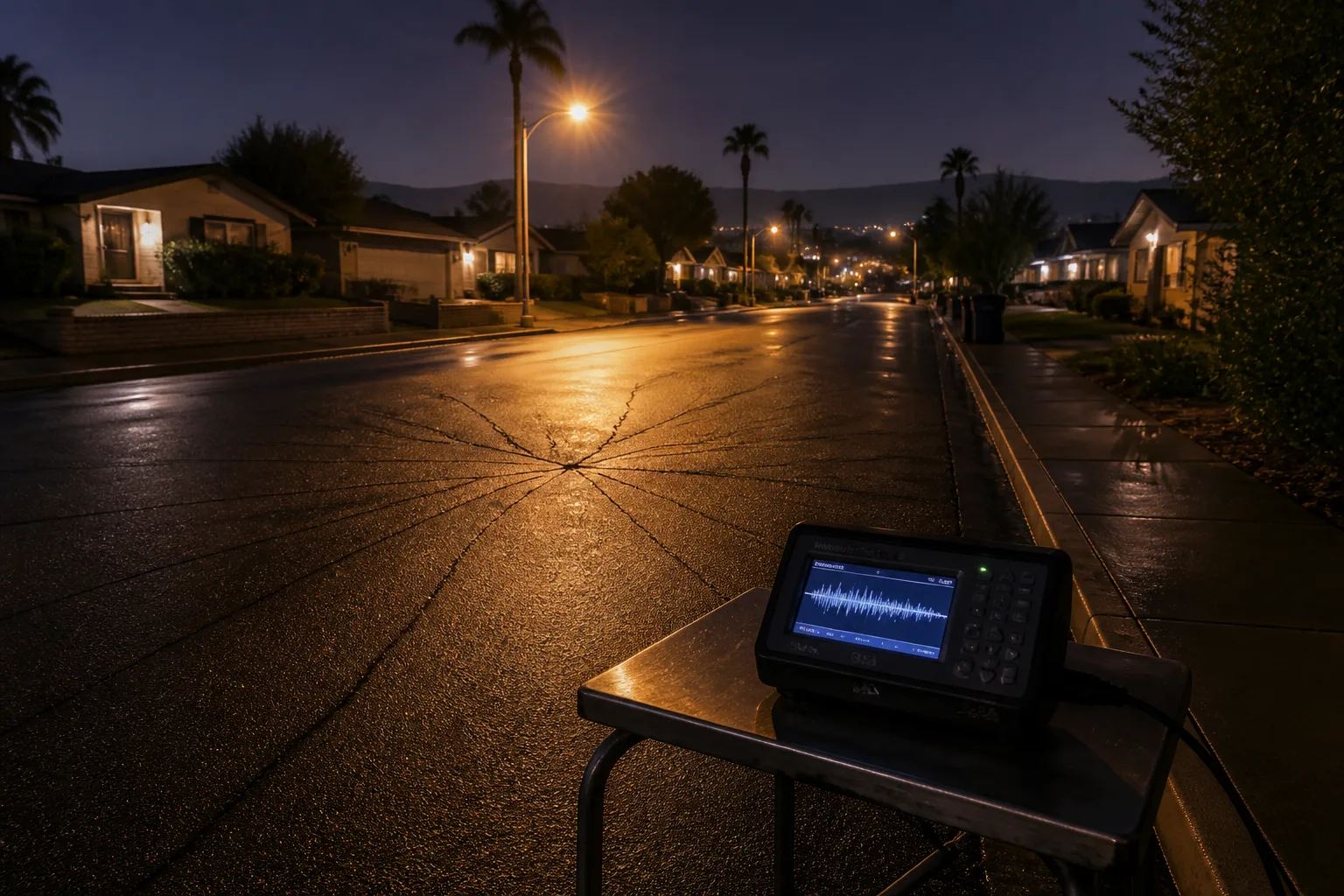
Magnitude-3.2 Earthquake Shakes Southern California Overnight, No Damage Reported
A faint tremor rippled through Southern California early Sunday morning, sending a small pulse of shaking across Los Angeles, Orange, San Diego, and Riverside counties. The U.S. Geological Survey recorded a shallow magnitude‑3.2 event at 07:13 UTC (12:13 a.m. PST) just south‑southeast of Compton, California. The quake’s epicenter lay 4 km (2.5 mi) SSE of Compton at a depth of 12.8 km (8 mi). 1,113 residents reported feeling the motion, and the maximum intensity reached Modified Mercalli Intensity 3.5—described by witnesses as weak to light. No injuries or structural damage were reported.
The fault line beneath the epicenter is the Newport‑Inglewood Fault Zone, one of Los Angeles County’s most prominent urban faults. The Los Angeles Times notes that this fault has been monitored for decades because it burrows beneath densely populated neighborhoods.
In response, Los Angeles County officials issued a reminder that earthquakes can strike anywhere and at any time. The County Office of Emergency Management urged residents and businesses to review emergency plans, practice the “drop, cover, and hold on” procedure, and maintain disaster supply kits. Officials also encouraged people to check evacuation routes and secure heavy furniture and appliances.
Compton, home to 95,740 residents as of the 2020 census, sits within the Gateway Cities region of the most populous county in the United States, which had an estimated 9.7 million residents in 2025. While the county’s infrastructure—including its extensive transportation network and public buildings—is built to withstand seismic activity, officials stress that preparedness remains essential.
This event fits a broader pattern of small earthquakes that frequently occur in Southern California. Although most are minor, they serve as reminders of the tectonic forces that shape the region. The USGS continues to monitor seismic activity along the Newport‑Inglewood Fault and other fault systems in the Los Angeles Basin.
Emergency preparedness guidance from the County Office of Emergency Management aligns with state and federal recommendations. Residents are advised to secure items that could fall during shaking, keep a supply of water, food, and medications, and establish a communication plan for family members. Businesses are encouraged to develop continuity plans that include evacuation procedures and backup power.
The California Department of Conservation’s Division of Earthquake Hazards publishes educational materials on earthquake safety, and the state’s building codes require new construction and major renovations to meet seismic design standards—standards that evolved after the 1933 Long Beach earthquake and the 1971 San Fernando earthquake.
Even small tremors can reveal weaknesses in older structures, so the County Office of Emergency Management has scheduled inspections of critical facilities in the wake of the event.
In the days following the quake, the USGS released a detailed event report, including a map of felt reports and a seismic waveform, available on its website for researchers and the public.
The incident underscores the importance of ongoing seismic monitoring and public education in California’s most seismically active region. Residents of Los Angeles, Orange, San Diego, and Riverside counties are reminded that preparedness is the best defense against future earthquakes.
No further action has been announced by state or county officials beyond the existing preparedness advisories, and the USGS will continue to monitor seismic activity in the area.