
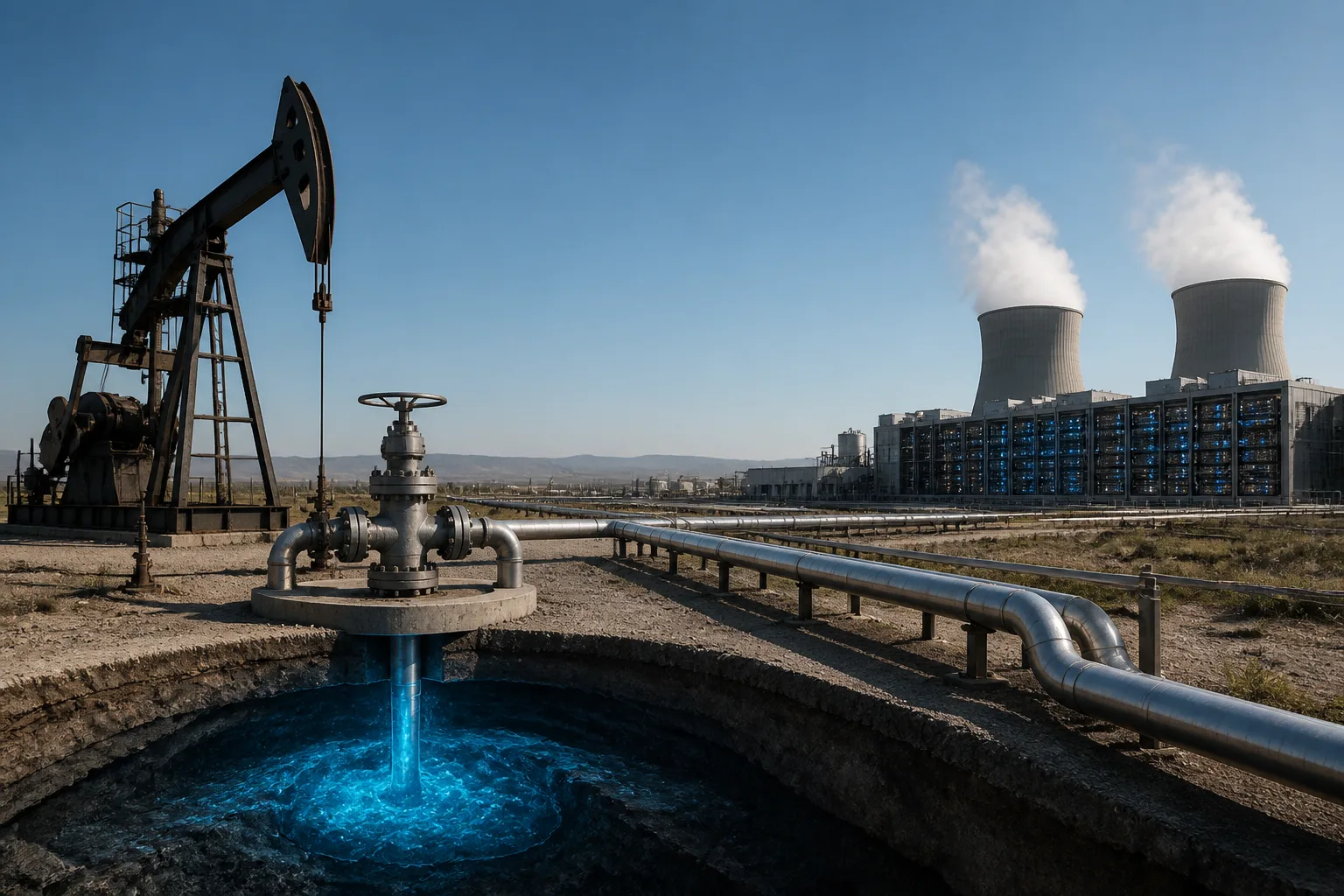
California Resources Corp. Begins First-of-Its-Kind CO Injection at Elk Hills, Plans Data-Center Campus
California Resources Corp. (CRC), the state’s largest oil producer, has started injecting carbon dioxide underground at its Elk Hills field in Kern County, marking California’s first operational carbon capture and storage (CCS) project. The injection, which began in May 2026, will store CO₂ captured from a nearby natural‑gas power plant in a depleted oil reservoir called Carbon TerraVault One (CTV I). CRC also announced plans to build a 100‑acre data‑center campus above the site, powered by the existing gas plant.
CRC, headquartered in Long Beach, California, spun off from Occidental Petroleum in 2014 and has operated the Elk Hills oil field since its discovery in 1911. The field, located about 20 miles west of Bakersfield, has produced roughly 1.5 billion barrels of oil and 4 trillion cubic feet of natural gas by the end of 2023. It remains the largest natural‑gas‑producing oil field in the state and the seventh‑most productive in the United States.
The CCS project is part of a joint venture between CRC and Brookfield, known as the Carbon TerraVault Joint Venture. In January 2025, CRC received final Class VI well permits from the Environmental Protection Agency for underground injection of CO₂ into the 26R reservoir at Elk Hills. The first injection of supercritical CO₂ took place on May 26 2026, according to a company release. Chief sustainability officer and executive vice president Chris Gould described the operation as “putting the carbon right back where it came from” and noted that the project is “first of a kind in the state in terms of storing, permanently and safely, carbon dioxide in the subsurface” and the first to store it in a depleted oil and gas reservoir.
The Elk Hills site already contains a network of wells, pipelines, and monitoring infrastructure that CRC has maintained for decades. The company has leveraged this existing footprint to enable the CO₂ injection, which will capture emissions from its natural‑gas power plant and sequester them in the reservoir’s porous rock. The project is intended to demonstrate California’s ability to store CO₂ safely and permanently, supporting the state’s broader climate goals.
In addition to the CCS effort, CRC has proposed a medium‑size data‑center campus covering 100 acres near Valley Acres in Kern County. The campus would be powered by the underused gas plant and would use closed‑loop cooling to reduce water consumption. According to a June 15 2026 company announcement, the data center would have a lighter impact on local water, power, and noise levels than comparable facilities. The proposal is part of CRC’s strategy to repurpose infrastructure originally built for oil production.
The data‑center plan aligns with California’s growing demand for data‑center capacity, driven by the expansion of cloud services and artificial‑intelligence workloads. By using existing power and cooling infrastructure, CRC aims to reduce the environmental footprint of the new facility. The company has not yet finalized the size of the data‑center in square‑foot terms, but earlier reports mentioned a 600,000‑square‑foot campus.
The dual initiatives at Elk Hills illustrate a broader trend among California oil companies to diversify into low‑carbon and technology sectors. The CCS project provides a concrete example of how oilfield infrastructure can be adapted for climate‑related purposes, while the data‑center proposal reflects the state’s need for high‑density computing facilities.
CRC’s first CO₂ injection has been completed, and the company is monitoring the storage site for safety and effectiveness. The data‑center proposal is still in the planning stage, with further approvals and design work pending. The projects are expected to contribute to California’s emissions‑reduction targets and to the state’s evolving energy and technology landscape.
The Elk Hills CCS project and data‑center plan represent California’s first steps toward integrating fossil‑fuel infrastructure with emerging low‑carbon and technology uses. The outcomes of these initiatives will likely influence future policy and investment decisions in the state’s energy and technology sectors.