
Southern California Faults Reach 1,000-Year Stress Peak, Study Finds
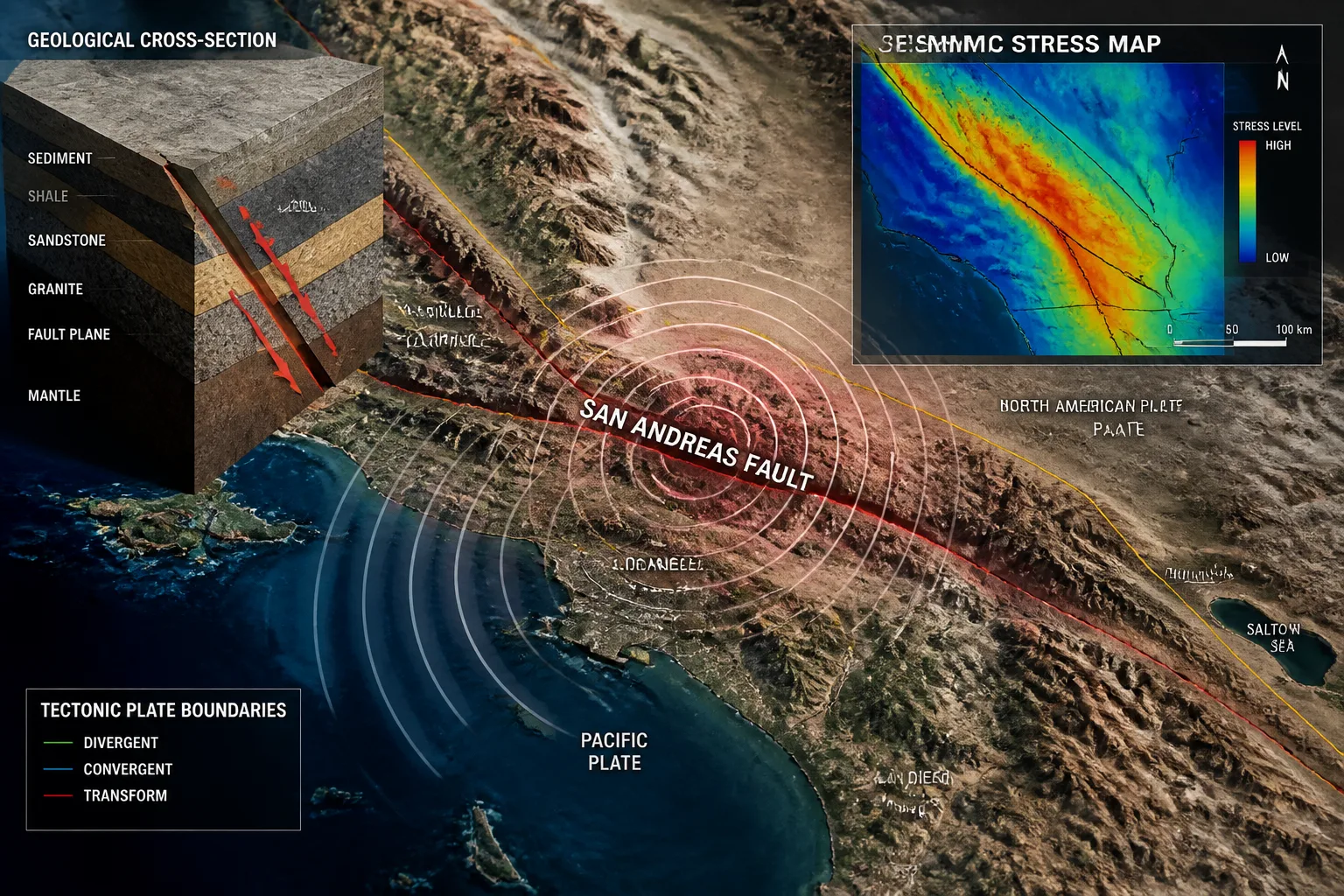
A new study by scientists at the University of Hawaii at Manoa reports that the San Andreas and San Jacinto fault systems in Southern California have accumulated tectonic stress at the highest level recorded in the past 1,000 years. The research, published in a peer‑reviewed journal, used a physics‑based model that incorporates 1,000 years of earthquake history to estimate the current stress state.
According to the study, the stress on both fault systems is now at a “critically loaded” level. The authors note that more than 160 years have passed since the last major rupture on the San Andreas Fault, a time span that exceeds the average recurrence interval for large earthquakes on that fault. The study also highlights the Cajon Pass, a mountain pass where the San Andreas and San Jacinto faults come close together, as an “earthquake gate.” Burkhard, the lead scientist, said the gate can sometimes block large ruptures from moving between the faults and, at other times, allow a single event to involve both systems.
The San Andreas Fault is a right‑lateral strike‑slip transform fault that runs roughly 650 miles from the San Francisco Peninsula to the Salton Sea. It marks the boundary between the Pacific Plate and the North American Plate. The San Jacinto Fault Zone, which runs through San Bernardino, Riverside, San Diego, and Imperial counties, is the most seismically active fault zone in the region and is considered part of the larger San Andreas transform system.
The model shows that stress normally released in large earthquakes has continued to build up to unprecedented levels. The researchers estimate that if a rupture were to occur, it could affect densely populated areas such as Los Angeles, San Bernardino, Riverside, and the Coachella Valley. The study does not predict when an earthquake might happen, but it indicates that the region is in a state of heightened seismic risk.
The Cajon Pass, located between the San Bernardino Mountains to the east and the San Gabriel Mountains to the west, sits at an elevation of 3,777 feet. It is a key transportation corridor that connects the Greater San Bernardino area with the Victor Valley and the Mojave Desert. Because the pass is a structural junction of the two fault systems, its role as an earthquake gate is of particular interest to scientists and emergency planners.
The findings are consistent with earlier reports that have shown stress levels on the San Andreas and San Jacinto faults reaching or exceeding the maximum recorded in the past millennium. The study adds a new dimension by explicitly modeling the interaction between the two faults and the potential for a joint rupture. According to the authors, the results improve understanding of earthquake interactions in Southern California and can help refine regional hazard assessments.
The research was funded by the National Science Foundation and involved collaboration with seismologists from several universities. The study’s authors emphasize that while the data indicate a high level of stress, they do not provide a specific forecast for an imminent earthquake.
Emergency management officials in California have long used seismic hazard maps to guide building codes and infrastructure design. The new stress estimates may lead to updates in those maps and in the planning of critical facilities. The California Department of Transportation and the California Office of Emergency Services are monitoring the study’s implications for infrastructure resilience.
The University of Hawaii team plans to refine its model by incorporating additional geological data and by testing scenarios that include potential triggering by distant seismic events. The research community will likely examine the study’s methodology and results in upcoming conferences and peer reviews.
In summary, the study confirms that the San Andreas and San Jacinto fault systems are under record stress, that the Cajon Pass can act as a gate for fault rupture, and that large earthquakes could impact major Southern California communities. The findings underscore the importance of continued monitoring and preparedness efforts in the state’s most seismically active region.